Why Your Brain Keeps Choosing What Hurts You
Understanding the hidden chemicals driving your behavior – “The Happy Chemicals”
Content Warning:
This article discusses addiction, mental health, and behavioral patterns. If you are currently struggling, you are not alone. Please see the Resource section below.
Introduction
If I’m being honest—my entire life, I never really thought about what was happening in my brain until I finally started getting sober. I hadn’t thought about receptors or chemicals or long-term effects. I was thinking about surviving. Getting through the day. Getting through whatever situation I was in at the time.
Since then, I’ve learned quite a bit—in treatment, in the halls, and a ton since in counseling and research. But even with that, I couldn’t have clearly explained how the chemicals we hear about all the time—like dopamine and serotonin—actually work in our brain or how they impact our mental health.
And for a long time, I looked at behaviors—mine and other people’s—as choices. Good choices. Bad choices. Smart decisions. Self-destructive ones. I knew it wasn’t quite that simple but I didn’t understand why it wasn’t … until I realized I needed to quit—and couldn’t.
Because I was an addict… I just hadn’t admitted it yet. Once you’re in addiction, you start to realize it’s not just about “making bad decisions.” There’s something stronger driving it. Something stronger than logic. Stronger than intention. That’s why they call addiction insanity.
And the more I’ve started to understand how the brain actually works… the more I’ve realized it’s not that simple at all—not even close. Because your brain doesn’t operate on logic the way you think it does. It operates on reinforcement. On learned patterns and behavior. On chemicals that are literally designed to push you toward certain behaviors—whether those behaviors are good for you or not.
And that’s the part that changes everything. Because when you start to understand that your brain can actually reward the very things that is hurting you, a lot of things start to make sense.
- Addiction.
- Toxic relationships.
- Burnout.
- Even the small things—like why you reach for your phone without thinking, or why calm can feel uncomfortable after chaos.
It’s not just about willpower. It’s not just about “making better choices.”
There’s something deeper happening. And once you realize that, your perspective really starts to change. I believe this is incredibly important to understand, which is why I’m turning this into an educational series over the next few weeks. This week is a high-level overview of the primary chemicals we hear about most often. Then in the following weeks, we’ll start breaking each one down individually—because once you understand them, you start to understand yourself and others a lot differently.
At the very instant that you think, “I am happy,” a chemical messenger translates your emotion, which has no solid existence whatever in the material world, into a bit of matter so perfectly attuned to your desire that literally every cell in your body learns of your happiness and joins in.
– Deepak Chopra
What Your Brain Is Actually Trying to Do
At the most basic level, your brain is trying to do two things:
- Keep you safe
- Make you feel good
The problem is… those don’t always line up as we normally think it should or how society believes it should. Sometimes what feels good isn’t safe. And what’s good for you doesn’t feel good, or at least not right away, if it’s not used to it.
That’s where these chemicals come into play.
The Core Chemicals (Simple Breakdown)
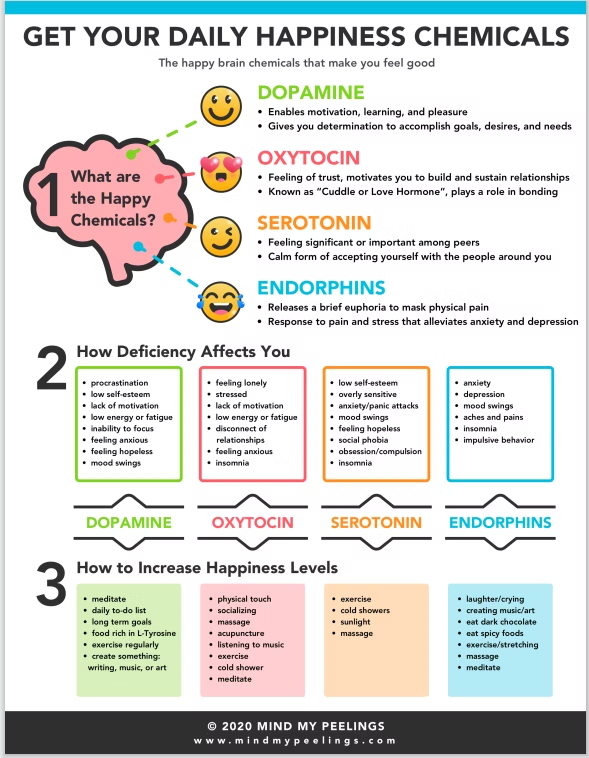
In the following, I am explaining the purpose of each chemical as simply as possible as I plan to deep dive into each in the following weeks:
Dopamine — “The Chase”
Dopamine isn’t happiness.
It’s the anticipation of something good.
It’s what makes you want something.
It’s what keeps you going back.
Your brain learns fast:
“That felt good… go get it again.” That’s how habits form. That’s how addictions form.
Serotonin — “The Stability”
Serotonin is what helps you feel… okay.
Not a high. Not a rush. Just steady.
It’s tied to:
- mood
- confidence
- emotional balance
But if your brain is used to chaos or constant stimulation, “okay” can feel like nothing.
Endorphins — “The Numbing”
Endorphins block pain.
Not just physical pain, but emotional pain too. Your brain uses endorphins as relief.
So, when something hurts, and you find something that takes that pain away quickly… your brain remembers it. And of course, it want’s to keep changing it when it’s gone.
Oxytocin — “The Connection”
This is the bonding chemical.
It creates:
- trust
- attachment
- emotional connection
But your brain doesn’t always know the difference between healthy and unhealthy connections. So, you can feel deeply attached to people who aren’t good for you,
and still feel pulled toward them.
Cortisol — “The Survival Mode”
Cortisol is your stress response.
It’s what kicks in when something feels wrong, overwhelming, or unsafe.
Short-term, it helps you react.
Long-term, it keeps your body stuck in survival mode.
And when you stay there long enough:
- you react faster
- think less clearly
- and fall back on patterns instead of logic
“Each happy chemical triggers a different good feeling. Dopamine produces the joy of finding what you seek– the “Eureka! I got it!” feeling. Endorphin produces the oblivion that masks pain– often called “euphoria.” Oxytocin produces the feeling of being safe with others– now called “bonding.” And serotonin produces the feeling of being respected by others–“pride.”
― Loretta Graziano Breuning
Why This Matters More Than People Think
These chemicals don’t work separately. They interact constantly.
So you can be:
- chasing something (dopamine)
- stressed (cortisol)
- emotionally attached (oxytocin)
- while not actually feeling stable (low serotonin)
And in the moment… it can still feel like the “right” thing to do. That’s why this isn’t just about willpower. Because your brain is being shaped—over time—by:
- what it’s exposed to
- what it’s rewarded for
- and what it’s trying to avoid
“I believe happiness is a chemical imbalance – it’s a silly thing to strive for. But satisfaction – if you seek satisfaction, you can succeed.”
— Lydia Lunch
The Hard Truth
You can’t “logic” your way out of something your brain has been chemically reinforcing.
But that doesn’t mean you’re stuck. It just means you have to understand what’s actually happening first.
If you’ve ever wondered:
- Why you go back to things that hurt you
- Why calm feels uncomfortable
- Why breaking habits feels almost impossible
- Why people you love still struggle to change
It’s not just about choice. It’s about how your brain has been wired over time.
“I used to mistake dopamine for the ‘happy-go-lucky’ chemical in my brain, but it’s a major source of my unhappiness, and it’s everywhere.”
— Naval Ravikant
In Closing & What’s To Come
(Part 1 of a Series)
This is Part 1 of a multi-part series breaking this into a very simple summary, explaining the purpose of each. However, over the next several weeks, I am going to go deep dive into each one:
- Dopamine — why you chase what you know isn’t good for you
- Serotonin — why “feeling okay” can feel so hard
- Oxytocin — why toxic relationships can feel addictive
- Endorphins — how we numb pain (and why it works)
- Cortisol — how stress rewires your brain and leads to burnout
Once you truly understand each of these individually, you start to understand your behaviors, and other people’s—a lot differently. Things start to make sense; even if we don’t like it.
If there’s one thing to take away from this: If you’ve ever questioned whether your brain is “broken”—believe me when I say, it isn’t. It’s doing exactly what it was designed to do.
The problem is, it doesn’t always know the difference between what’s helping you and what’s hurting you. And as difficult as that can be to navigate, understanding the core reasoning behind it can be incredibly helpful in learning how to cope. That’s when things can really start to change.
We can begin to build awareness in our everyday lives—long after the initial healing begins. Because being aware in the moment is how you start to change the path you take and your reactions.
Talk Next Week!
Resources
If you or someone you know is struggling, please reach out to one of the following resources:
- In the U.S., you can call or text 988 for the Suicide & Crisis Lifeline
- You can also visit 988lifeline.org for support
- If you are struggling with addiction, please call (SAMHSA) National Helpline at 1-800-662-HELP (4357)
- If you are in immediate danger, always call 911
References
National Institute on Drug Abuse (2020). Drugs, brains, and behavior: The science of addiction
Harvard Health Publishing. (2019). Dopamine: The reward molecule.
Cleveland Clinic. (2022). Dopamine: What it is & what it does.
Cleveland Clinic. (2022). Serotonin: What it is, function & levels.
Cleveland Clinic. (2022). Endorphins: What they are and how they work.
Cleveland Clinic. (2022). Oxytocin: What it is, function & effects.
Mayo Clinic. (2021). Chronic stress puts your health at risk.
American Psychological Association. (2020). Stress effects on the body.
National Institute of Mental Health. (2023). Mental health information and brain function.


Leave a Reply! I would love to hear your thoughts on todays topic!